Are AI photo apps safe for private portraits? What to check before uploading
Check who processes your references, what stays private, and what deletion covers before uploading personal photos for an AI portrait set.
At a glance
- Check application access and generation-provider processing separately.
- Ask what deletion covers for references, results, logs, and backups.
- Upload only after the answers meet your own comfort level.
An AI photo app is not automatically safe for private portraits because it requires a login or calls an album private. You need to know who can access the files, which provider processes them, how long each system keeps them, and what happens when you ask for deletion.
For personal or boudoir-inspired pictures, an unanswered question can be a good reason to delay the upload. You do not need to upload a sensitive photo to find out whether you are comfortable with the service.
Separate the information you are sharing
There are several things to review: the original reference photo, the generated portrait, the prompt and project settings, and your account information. A service can handle these differently. Deleting a generated picture does not, by itself, tell you what happened to the reference that created it.
Look at your reference beyond the face. Does it contain another person, a recognizable home interior, a document, or information you do not need to submit? Choose a simpler photo when possible. Use only your own images or images of a consenting adult who understands the intended use.
The reference-photo checklist helps you choose useful inputs without collecting unnecessary pictures. For style exploration, the own photos or virtual model guide explains the alternative of starting with a fictional person.
Use a question-by-question check
| Question | Where to look | If the answer is unclear |
|---|---|---|
| Are my uploads or outputs public by default? | Upload screen, album controls, privacy policy | Do not assume a private account makes every asset private. |
| Can the operator or support staff access files? | Policy, access explanation, support response | Ask about operational access instead of accepting "only you" without detail. |
| Does another provider receive my photos? | Provider disclosure and generation settings | Ask which processor handles the request and which terms apply. |
| Are inputs or outputs used for training? | The service's terms and the applicable provider terms | Do not infer a no-training promise from the word "private." |
| How long are references, results, and logs kept? | Retention section and deletion instructions | Ask separately about active storage, logs, and backups. |
| What does deleting an item remove? | Deletion confirmation and documented process | Keep the item identifier and request a clear explanation of scope. |
| What changes when I share or download? | Sharing controls and your destination app | Review the destination's access and backup settings before sending. |
You do not need a security vocabulary to ask these questions. A useful answer names the data, the system, and the action. "We take privacy seriously" does not tell you whether a reference reaches a generation provider.
What AIGirlShot's policy says
AIGirlShot's privacy policy says that private reference photos, models, and albums are associated with your account and excluded from the public catalog and sitemap. Private endpoints check account ownership, and private pages are excluded from public HTML caching.
The policy also says the configured generation provider receives the prompt and reference images required for a request. That provider's processing and retention terms apply to what it receives. An image-model name in a quote does not answer every question about the service processing that model request.
Project information and generated assets are kept so you can return to your work. The policy explains that deletion can involve multiple storage systems, with a provider's logs and backups governed by its own processes. It does not make a universal promise of immediate deletion from every system or a universal no-training guarantee.
These statements describe specific boundaries. They should not be read as a claim that only the account holder could ever access a file, or that any online service can provide absolute security.
Ask for a concrete answer before uploading
If a missing detail would change your decision, use Contact. A useful question is: "Which generation provider will receive my reference photos, what retention applies to this request, and what deletion options cover those copies?"
For an existing item, include the account email and relevant item identifier so support can locate the request. Avoid attaching the sensitive image again unless it is necessary and you are comfortable doing so. The policy explains that account verification may be needed for privacy requests.
If the answer does not meet your needs, stop before uploading. A virtual-model project can help you judge an aesthetic, but it does not test how faithfully the service will reproduce your own face.
Keep the download decision separate
A file can leave the app's access controls when you download or share it. Consider whether the device is shared, whether a photo library syncs to another account, and who can open the destination folder or album.
Before you generate, decide where you want the final pictures to go. Afterward, follow the private portrait storage and sharing guide. If you continue with personal references, the first photoshoot walkthrough picks up at reference selection and planning.
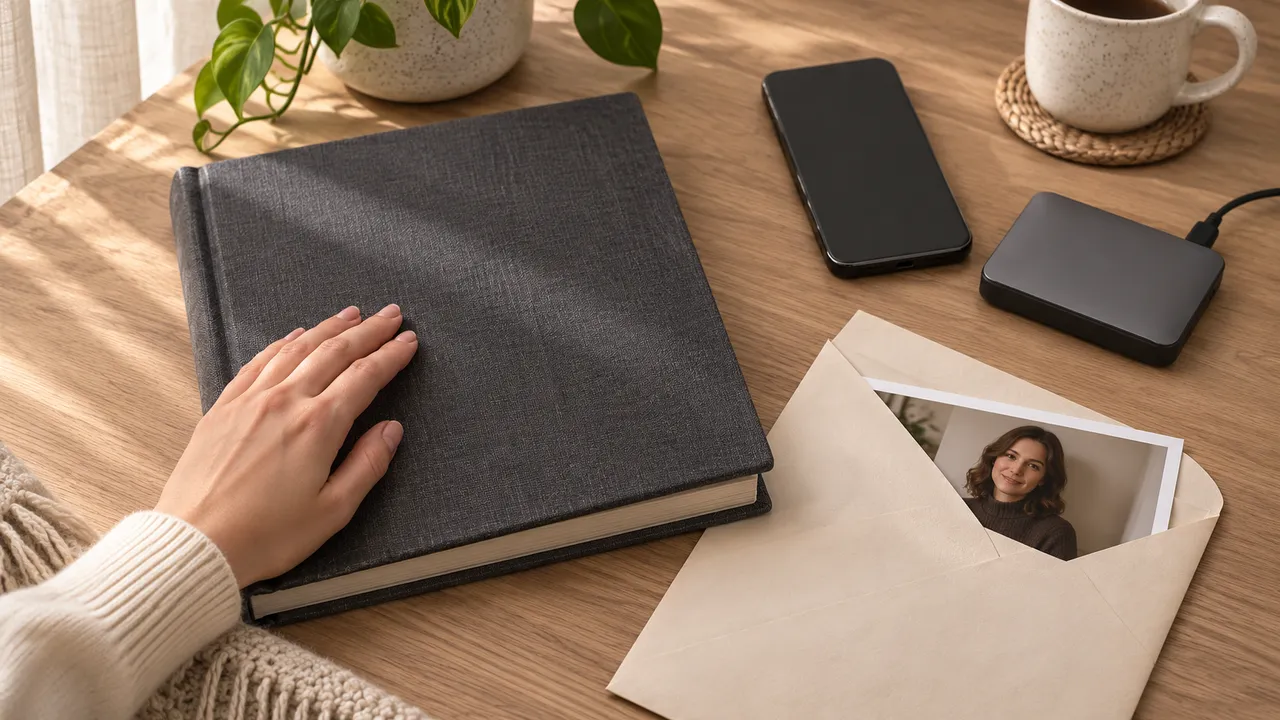
Cover: AI-generated editorial illustration, not an AIGirlShot result.
Sources
Written by
AIGirlShot Team
Portrait planning and practical guides from the AIGirlShot team.
Related posts